The Safest Path to Stable Climate Is Designing New Plants
Plant biotechnology and engineered plant systems as tools for biospheric stewardship.
Read in Palladium MagazineSource essay: The Ecology of Arcadia (PDF)

Team
Founder and biological-program lead
Scientific practice
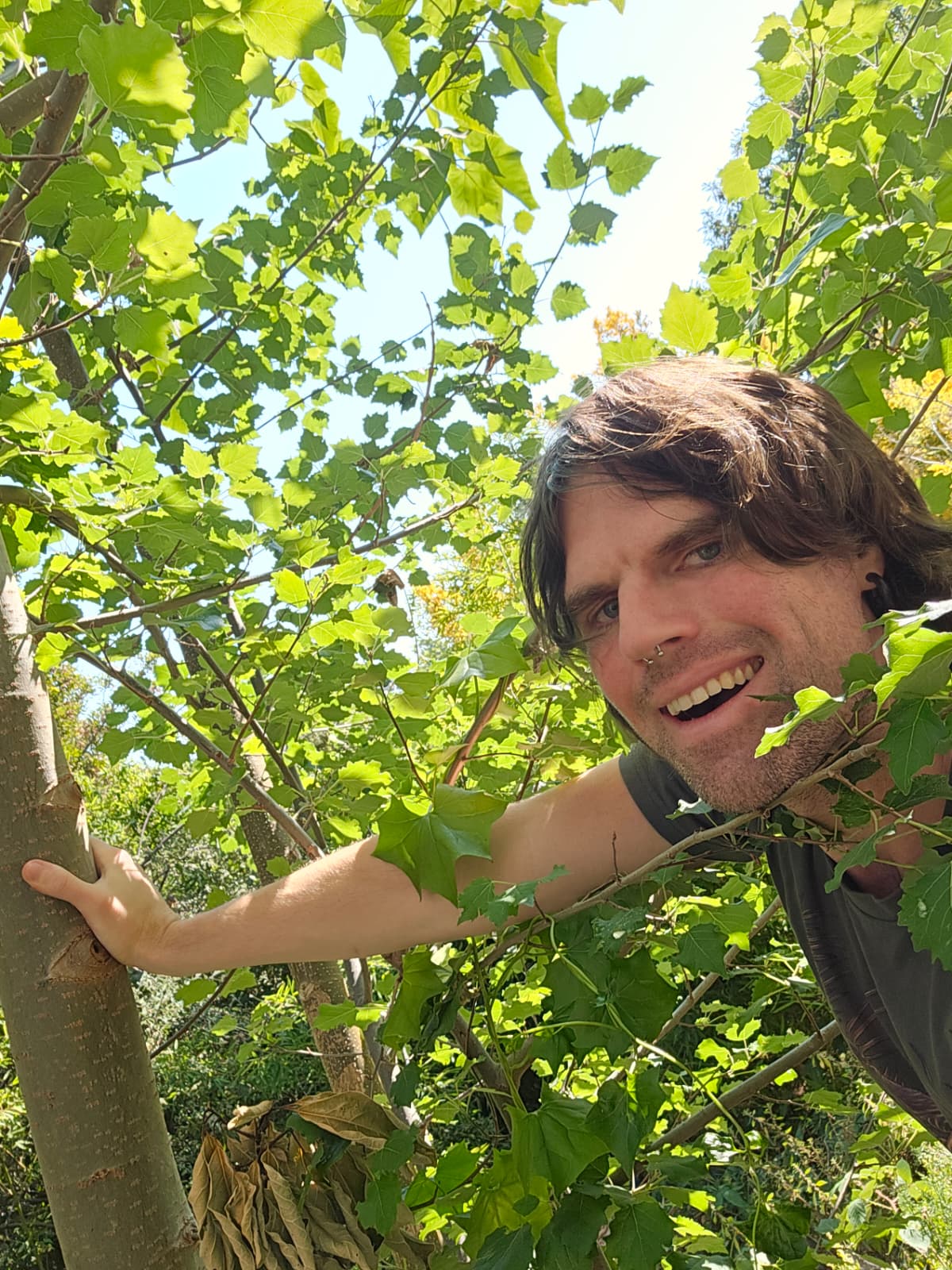
Patrick currently leads Carbocene’s work in photosynthesis-enhanced tree research, new plant-biotechnology development, greenhouse and propagation systems, deployment planning, field and institutional development, and preparation for longer-term grants and partnerships.
His close involvement with plant care, propagation, greenhouse maintenance, experimental planning, biochar, and field activity keeps research decisions connected to the condition of the plants and the practical constraints of maintaining them.
That direct involvement connects scientific ambition to biological time: seasons, growth, stress, recovery, and the accumulated judgment required to keep an experiment alive. Research directions move forward according to their current technical status, funding, rights, and appropriate scientific relationships.
Scientific and intellectual formation
Patrick studied biological sciences, paleobiology, and botany at Oxford. He later studied and taught philosophy at San Francisco State University, with research interests involving consciousness, episodic memory, empathy, temporal representation, attention, and early modern rationalism.
He was selected as a Foresight Fellow in 2019. The early Carbocene framework emerged from the 2019 Foresight Planeteers workshop and was subsequently developed with Linda Maepa and Rob Ferber around biological productivity, carbon flux, decomposition, durable materials, and the integration of engineered plants into larger physical systems.
Living Carbon became one important setting in which parts of that broader program were developed. Patrick later established Carbocene in its present nonprofit form to pursue the program through integrated biological development, field research, measurement, and productive use.
Historical role
Patrick co-founded Living Carbon and served as its chief technology officer, leading technical work within a collaborative program that carried engineered plants from laboratory development through propagation, field trials, and operational forest projects. Carbocene is the independent nonprofit institution he founded to carry plant biotechnology into a new scientific and field stage.
From argument to living technology
In that earlier role, Patrick helped conceptualize and develop a plant-biotechnology program spanning photosynthesis enhancement, biological durability, plant engineering, event selection, propagation, greenhouse systems, growth evaluation, and biomass analysis.
The program was collaborative and depended on scientists, horticultural staff, transformation partners, forestry researchers, and operational teams. Patrick’s technical role extended through nursery scaling, regulatory strategy, field trials, landowner and site relationships, forestry operations, commercial planting, field measurement, and work with carbon buyers and standards.
Carbocene builds on direct experience with both sides of the deployment boundary: creating engineered plants and carrying them into operational landscapes, then rebuilding biological capability when institutional support changed.
Selected earlier work
Patrick’s earlier work spans paleobiology, plant biotechnology, forestry, and philosophy. These articles, talks, and academic publications helped form questions that Carbocene now carries into practice. They are part of his prior record, not work produced by Carbocene.
Plant biotechnology and engineered plant systems as tools for biospheric stewardship.
Read in Palladium MagazineSource essay: The Ecology of Arcadia (PDF)
What the paleoclimatic record reveals about carbon drawdown, climate stability, and active biological intervention.
Read in Palladium MagazineSource essay: Deep Time Perspectives on Climate Change (PDF)
Recorded in 2019, this Foresight Fellowship presentation shows the Carbocene architecture before its later division into separate projects: enhanced biological productivity, carbon retention, durable materials, and planetary stewardship are already argued as one system.
Watch the presentationPeer-reviewed controlled-environment research reporting increased photosynthetic efficiency and above-ground biomass in engineered hybrid poplar.
Patrick is one of sixteen co-authors.
View the journal recordView the full archive of earlier work that helped shape Carbocene
Selected reporting on earlier work
Fast Company
Early direct attribution of the combined photosynthesis-and-retention framework.
Read the Fast Company reportScience
Experimental results and independent scientific context.
Read the Science reportMIT Technology Review
Long-form scientific and intellectual history.
Read the MIT Technology Review accountThe New York Times
Field-planting milestone.
Read The New York Times reportMongabay
Balanced scrutiny of the technology’s promise and unresolved ecological questions.
Read the Mongabay reportThese independent sources document work conducted before Carbocene’s founding and Patrick’s professional and scientific history.
Poetry
Patrick is also the author of Alkali Shores , a 2019 collection of poems concerned with biological and cultural history, desert ecology, perception, mythology, and planetary time.
Institutional capacity
Patrick personally carried greenhouse operations and biological inventory through Carbocene’s formation while directing the next stage toward propagation, field science, measurement, and productive use.
Carbocene turns that base into shared technical infrastructure: living research collections, records, facilities, field practice, technical memory, and relationships that allow collaborators to move useful biology into larger programs across long biological timelines.
Carbocene is the institution
Patrick’s role is to lead biological programs while building the conditions for scientists, landholders, students, funders, and community researchers to produce measurable biological and physical outcomes.